




Press-In Inserts vs. Molded-In Inserts: A Complete Comparative Analysis for Modern Manufacturing!
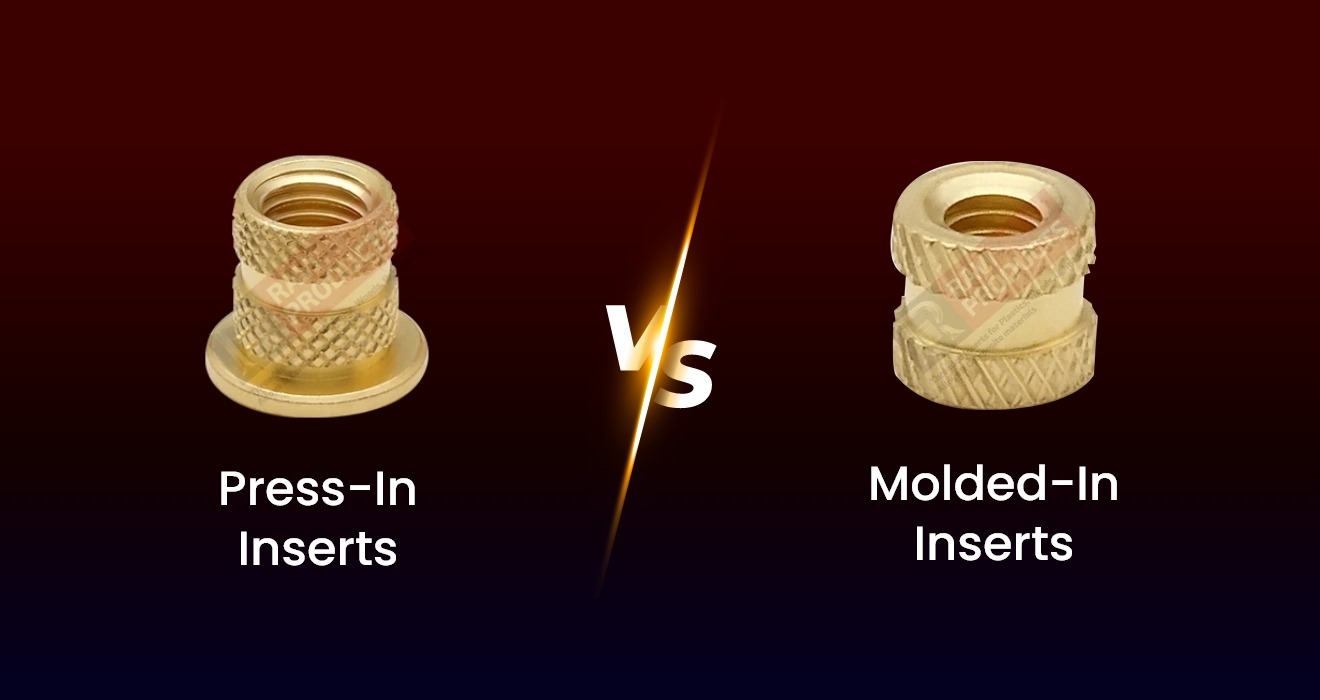
When designing threaded plastic assemblies, selecting the right insert type is crucial for ensuring strong fastening performance and long-term reliability. Press-in inserts and molded-in inserts are two widely used solutions, each suited to different manufacturing requirements. Press-in inserts are installed after the plastic part is molded, offering flexibility, easier rework, and suitability for lower-volume production. In contrast, molded-in inserts are positioned in the mold before injection, allowing the plastic to form tightly around the insert and deliver superior
strength and load-bearing capability.
Ravi Products, a trusted manufacturer of precision-engineered brass inserts, provides both press-in and molded-in inserts to meet diverse industrial applications. Understanding the difference between these two insert types helps engineers choose the most efficient and cost-effective approach for their specific product needs.
Manufacturing of Press-In Inserts
-> Press-In Inserts are designed to be pressed into a straight hole in a plastic component without the need for heating the material. Their construction allows them to fit securely while minimizing stress on plastic.
1. Typical designs include:
-
- Internal threads are surrounded by a diamond knurl on the outer diameter, which helps grip the plastic for improved pull-out resistance.
- A partial slit along the knurled length enables the knurled section to compress slightly when inserted, reducing the chance of cracking the plastic.
- A smooth pilot section that helps guide the insert straight into the hole during installation.
- Some designs include an optional flange to increase resistance to pull-through forces.
- Other variations use a hex-shaped body with barbs to resist torque-out and pull-out without the need for knurls or slits.
- These inserts are commonly made from brass or lead-free aluminum, with stainless steel available for applications where additional strength is needed, though stainlessness is less common for slotted varieties.
2. Installation Method
-
- Press-In Inserts are installed after the plastic part has been molded, and no heat is used during the process. The insert is pressed into the hole by means of a controlled interference fit.
- The slit allows the knurled outer surface to compress slightly, reducing stress and lowering the risk of cracking the plastic.
- Once a screw is threaded into the insert, it forces the insert to return toward its original diameter, causing the knurls to embed into the surrounding plastic, improving mechanical engagement. This installation process is quick and does not require specialized equipment, making it efficient for many assembly environments.
3. Advantages
-
- Quick and cost-effective to install.
- Does not require heat or complex equipment.
- Provides good torque-out and pull-out resistance in softer plastics.
- Well-suited for light to moderate load fastening needs.
4. Limitations
-
- Lower performance compared to molded-in or heat-staked inserts.
- Excessive interference can risk cracking in stiffer plastics.
- Not ideal for high-load or structural applications.
Manufacturing of Molded-In Inserts
-> Molded-In Inserts are placed into the mold cavity before the plastic is injected. This allows the plastic to form around the insert as it solidifies, creating a strong and permanent mechanical connection.
1. They are often:
-
- Maximize the outer surface area to improve both pull-out and torque-out resistance.
- Include grooves or undercuts between knurled regions to further lock the insert in place.
- Are available in both blind and through-threaded configurations, depending on the design needs.
- They are commonly manufactured from brass, aluminum, or stainless steel, chosen based on corrosion resistance or electrical requirements.
2. Installation Method
-
- During molding, the inserts are held in place on pins inside the mold cavity.
- The molten plastic is injected into the mold, flowing around the insert and solidifying to create a complete bond. When the mold opens, the pins withdraw, leaving the insert securely anchored in the final plastic
part. - This method is especially useful for thermoset plastics, which cannot be reheated and therefore cannot accept heat-staked inserts.
3. Advantages
-
- Provides the highest pull-out and torque-out strength.
- Permanent, precise placement.
- Suitable for plastics that cannot be reheated.
4. Limitations
-
- Most costly installation methods.
- Requires custom molding tools for each new (or changed) part design.
Key Performance Comparison
| Press-In Inserts | Molded-In Inserts |
|---|---|
| Press-in inserts provide good pull-out strength, suitable for applications where loads are moderate. | Molded-in inserts offer the highest pull-out strength, making them ideal for applications requiring maximum retention and durability. |
| Press-in inserts provide good torque-out resistance, performing reliably when moderate rotational forces are applied. | Molded-in inserts provide excellent torque-out resistance, ensuring the insert remains secure even under high rotational stress. |
| The installation cost is low because press-in inserts require no specialized heating or molding steps. | The installation cost is higher because molded-in inserts require additional tooling and integration during the molding process. |
| Little to no specialized equipment is required to install press-in inserts, making them easy to use in standard assembly environments | Injection mold tooling is required, meaning installation must be planned during the molding stage and cannot be easily altered afterward. |
| There is a risk of cracking stiffer plastics during installation due to the reliance on interference fit. | The risk of damage is very low once the insert is molded in, because the plastic solidifies around the insert in a controlled manner. |
Application Scenarios
1. Press-In Inserts recommended for
-
- Components with low to moderate load requirements.
- Electronics and interior assemblies, such as automotive dashboard buttons and displays.
- Applications where weight reduction and quick assembly are priorities.
2. Molded-In Inserts recommended for
-
- Weather-sealed enclosures require strong mechanical fastening.
- Applications requiring corrosion resistance, permanent alignment, and high structural strength.
- Use thermoset plastics that cannot be heat-processed after molding.
In conclusion, selecting the appropriate insert type, whether press-in or molded-in, plays a crucial role in ensuring performance, durability, and efficiency in plastic assemblies. With the right guidance and high-quality components, manufacturers can achieve reliable fastening solutions tailored to their specific applications. Ravi Products is committed to providing precision-engineered brass inserts and dependable service. To learn more, request a quote, or discuss requirements, contact us at export@raviproducts.com or call +91 97253 14757.