

Aluminum vs Brass Threaded Inserts: Performance Comparison
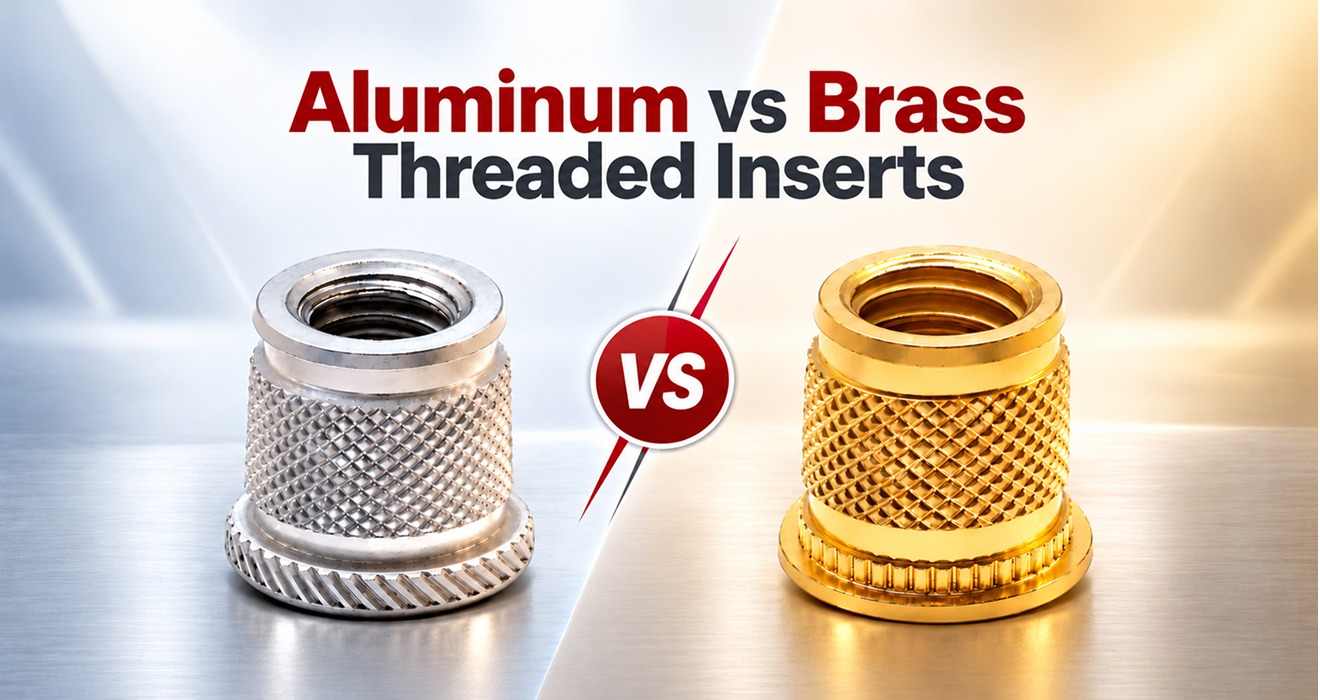
These inserts are two of the most widely used solutions for creating strong, durable threads in materials that cannot reliably hold repeated screw installations. At Ravi Products – The best threaded inserts manufacturer, we provide precision-engineered, custom-made threaded inserts designed to deliver reliable fastening performance across various industries. While aluminum and brass inserts differ significantly in strength, weight, corrosion resistance, thermal conductivity, and application suitability, selecting the right material depends on factors such as operating conditions, mechanical loads, and the base material being fastened.
Aluminum Threaded Inserts: Advantages and Limitations
Aluminum has been used in industrial applications since the early 20th century because of its lightweight, corrosion-resistant properties. Today, these inserts are commonly used for applications where reducing weight is a priority without sacrificing performance.
Advantages
- Lightweight Design: Reduces overall component weight, making it ideal for automotive and aerospace applications.
- Excellent Corrosion Resistance: Naturally resists corrosion for long-lasting performance in demanding environments.
- High Thermal and Electrical Conductivity: Provides efficient heat transfer and good electrical conductivity while remaining non-magnetic.
- Easy Machinability: Simplifies manufacturing and helps reduce production time and costs.
- Highly Recyclable: Supports sustainable manufacturing through excellent recyclability.
Limitations
- Lower Wear Resistance: Softer material is more prone to thread wear under repeated use.
- Higher Thermal Expansion: Expands more with temperature changes, which may affect joint stability.
- Lower Strength Than Brass: Offers lower inherent strength, though heat-treated alloys can significantly improve performance.
Brass Threaded Inserts: Advantages and Limitations
These are widely used in industries where corrosion resistance, conductivity, and ease of installation are important. They are commonly found in electrical components, plumbing fixtures, marine hardware, appliances, automotive systems, electronics, aerospace, HVAC equipment, and telecommunications products.
Advantages
- Excellent Machinability: Enables precise manufacturing with efficient machining.
- Strong Corrosion Resistance: Delivers reliable performance in corrosive environments.
- Superior Wear Resistance: Withstands repeated assembly and disassembly with minimal thread damage.
- High Thermal and Electrical Conductivity: Provides efficient conductivity while remaining non-magnetic.
- Balanced Performance: Combines strength, durability, corrosion resistance, and machinability for versatile use.
Limitations
- Higher Material Cost: Typically costs more than aluminum and steel.
- Lower Strength: Not suitable for the highest-load fastening applications.
Comparison Table
| Performance Factor | Aluminum Threaded Inserts | Brass Threaded Inserts |
|---|---|---|
| Weight | Lightweight (2.7 g/cm³), ideal for weight-sensitive applications | Heavier (8.4 g/cm³), less suitable where weight reduction is critical |
| Wear Resistance | Softer and more prone to thread wear with repeated use | Better wear resistance for high-cycle fastening |
| Strength | Lower in raw form; improved through heat treatments | Higher strength than aluminum |
| Thermal Expansion | Higher expansion rate, which can affect stability during temperature changes | Lower expansion rate for better dimensional stability |
| Cost | More cost-effective for lightweight applications | Higher cost due to material value |
Selecting Between Aluminum and Brass Threaded Inserts
Aluminum threaded inserts are well suited for applications where lightweight construction, corrosion resistance, thermal conductivity, and recyclability are key priorities. Their performance can be further enhanced through heat-treated aluminum tempers, making them a viable alternative in weight-sensitive industries such as automotive and aerospace.
Brass threaded inserts are better suited for applications requiring greater wear resistance, excellent conductivity, corrosion resistance, and a balanced combination of strength and machinability. Although more expensive than aluminum and steel, brass remains a preferred choice across many industries because it offers a practical balance of performance characteristics.
Conclusion
Both aluminum and brass threaded inserts offer distinct advantages, making the right choice dependent on your application’s performance requirements. By considering factors such as weight, strength, wear resistance, and operating conditions, you can select the insert material that provides the best balance of reliability, efficiency, and long-term value.
Contact Us
At Ravi Products, we manufacture high-quality threaded inserts for a wide range of industrial applications. Whether you need aluminum, brass, or custom threaded inserts, our team is ready to help you choose the right product. Contact us Today, discuss your requirements and find the ideal solution for your project.